AI in Manufacturing Quality: Hype or Real Value?

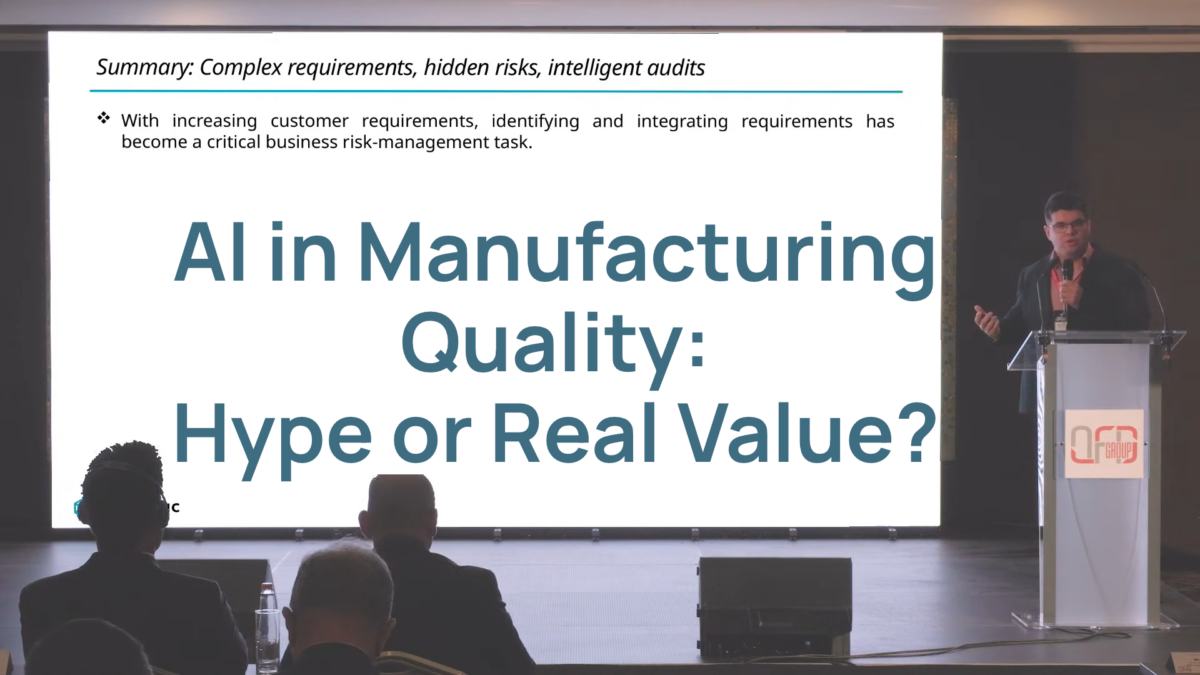
Can AI deliver real value in manufacturing quality management? In this presentation, Dr. Péter Bereczki, Quality Management Director at Arconic Köfém in Székesfehérvár, Hungary shares his experience of applying AI to practical quality management challenges.

Recorded at QFD Group’s 15th Annual Gathering of Regional Automotive Decision Makers, the presentation explains why Arconic’s quality team outgrew spreadsheet-based processes, why they chose QualityAI, and how they’ve started using it to review customer-specific requirements and to plan and run internal audits.

Péter also lays out where he wants to take it next: analyzing audit findings across the whole organization, so internal auditing becomes an input to management decisions instead of compliance paperwork.

The presentation also demonstrates how AI can help quality teams work more efficiently, identify business risks and turn audit insights into actionable management feedback.

Watch the presentation below to discover how AI is being applied to real-world manufacturing quality challenges.

(Péter presented in Hungarian; this recording has been dubbed to English.)

Explore the key topics and jump directly to the relevant sections of the video:

  • 00:00 — Péter’s introduction: from research to quality leadership

  • 00:57 — AI in everyday life and quality management

  • 03:20 — Arconic: company, products and customers

  • 08:09 — Arconic’s challenges: customer requirements and a lean quality team

  • 10:00 — Moving from Excel to AI-supported quality management

  • 11:25 — Managing requirements and planning internal audits

  • 14:14 — Turning audit findings into management feedback

  • 15:43 — “The most powerful management tool”

  • 17:02 — Choosing QualityAI and professional implementation support

  • 17:55 — Reviewing and summarising customer requirements with QualityAI

  • 19:40 — AI recommendations for process and product audits

  • 20:09 — Mobile audit evidence, evaluation and IATF references

  • 21:13 — Business risks: documentation, complaints and additional costs

  • 22:36 — Using AI and audit insights for strategic decisions

  • 24:28 — Arconic anniversary film

Interested in seeing how QualityAI could support your organisation?
Hungarian

Spanish

German

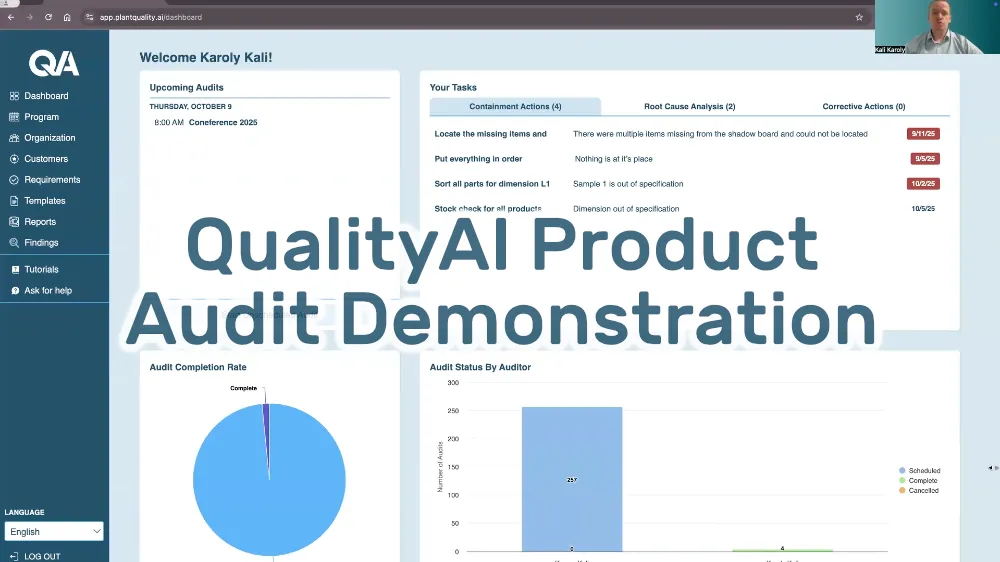
QualityAI Product Audit Demonstration

Process audits show that the work should deliver quality. Product audits prove that it does.

Whether it’s a Dock Audit or a VDA 6.5 product audit, our AI Scoring Agents help you close the loop. They capture findings, apply consistent scoring, prioritize result risks, and instantly generate actionable reports—giving you the full picture of process and product performance.

Here are the topics (and associated clickable timestamps) covered in this short demonstration video:

  • 0:10 Engine extracts characteristics and tolerances from a customer drawing
  • 0:45 Characteristics automatically formatted to be able to simply paste into a spreadsheet.
  • 1:09 Using the fully-customizable Risk Matrix to prioritize your product audit
  • 1:50 Creation of a product audit, showing a characteristic-by-characteristic flow, including ad hoc, configurable sample sizes
  • 3:47 Product audit using an alternative sample-by-sample flow
  • 4:47 Product characteristic deviation example with containment actions
  • 5:58 AI analysis and insights from product audit, including summary, scoring based on your custom criteria, comparison to similar audits, failure trends and patterns, notable successes, immediate risks, and much more

QualityAI “Build Your Own Agent” Demonstration

Click to watch instantly, or scroll down to discover what is demonstrated in this short video.

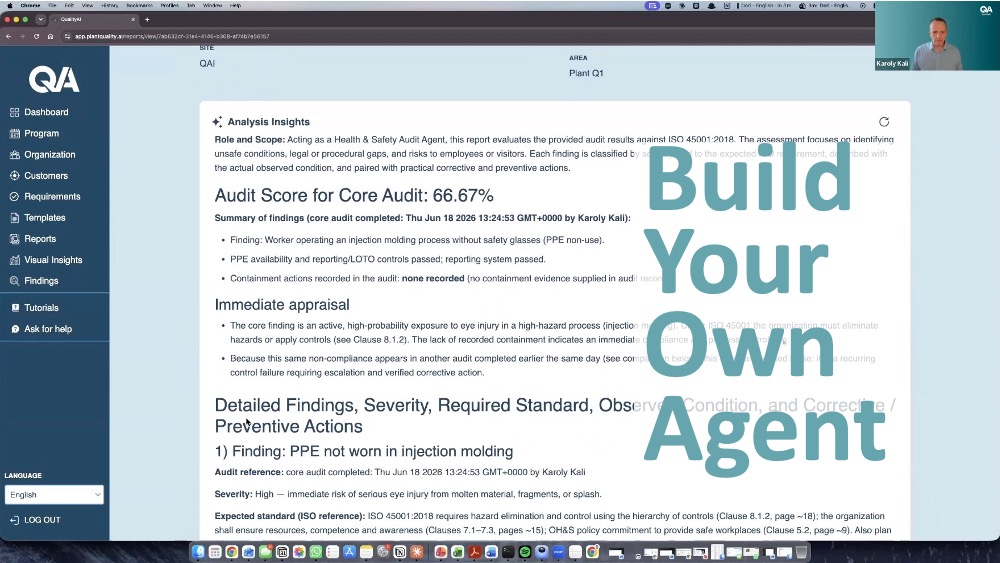
This excerpt shows how simple it is to build your own Safety Audit Agent, using an ISO 45001 requirement document.

It shows how to configure the agent and create the audit template, performing the audit live on a mobile device.

After that, the AI agent does the following:

  • Generates an analysis of the audit, referencing applicable ISO 45001 standards
  • Scores the audit based on any customer-provided scoring instructions, or will fallback to its own analysis otherwise
  • Detailed findings and severity
  • Corrective/preventative actions
  • Comparison with previous audits, finding reoccuring patterns and showing immediate containment actions
  • Root-cause corrective actions, verification and closure
  • Context from related audits to provide comparison and systemic context
  • Prioritized recommendations for a consolidated corrective program
  • Verification and evidence requirements for closure
  • Summary of ISO 45001 requirements, showing clauses and relevant pages